ORGANS OF PARIS © 2026 Vincent Hildebrandt HOME ALL ORGANS



E6
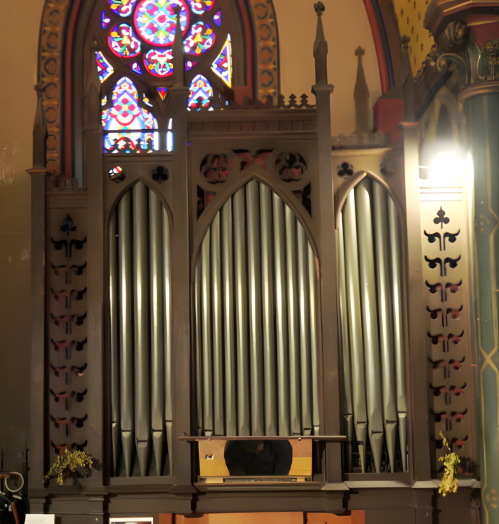
In this church there was a choir organ bearing the
inscription “Repaired by E. and J. Abbey, Versailles”. Its
unusual feature was that it stood in the same gallery as the
grand organ, on the right-hand side when facing the organ
case, and slightly lower down.
The instrument dates back to an earlier construction,
probably contemporary with the building of the church.
Indeed, the general appearance of the surviving elements
suggests an instrument by Suret or Stoltz.
The Abbey firm completely rebuilt the instrument at the
beginning of the twentieth century, and it was inaugurated
“like a grand organ” by Alexandre Guilmant on 25 January
1900 (see *Le Monde Musical* XII/2 [30 January 1900], p.
27).
In 1993, the instrument was destroyed—perhaps ‘inspired’
by what had happened to the grand organ at the nearby
Notre-Dame de la Lorette—and replaced by a new
instrument built by François Delangue in a neo-Baroque
style. It was installed in the old case, reusing some elements
of the original organ.
Source: La Flûte Harmonique, no. 65, 1993

Composition of the former choir organ
Originally, the organ had a 54-note soundboard
with eight stops and a double channel, together
with a second soundboard with 37 notes and four
stops. Later, a five-note extension soundboard
was added, extending the compass of the Récit to
42 notes. (Both manual keyboards have 54 notes
at the console.) The pedalboard has retained its
compass of 25 notes.
Here is the specification as it can be read at the
console (the Récit stops are shown in italics):
Grand-orgue
Bourdon 8
Flûte harmonique
Montre 8
Prestant 4
Doublette 2*
Plein-jeu*
Trompette 8
Clairon 4
Récit expressif
Viole de Gambe
Flûte octaviante
Voix céleste
Hautbois 8
[Appel] Soubasse [de Pédale]
Tirasse G.O.
Copula
Expression
Appel Anches G. O.
Appel Bourd. 16 & Montre 8
Appel Prestant
*The Plein-jeu stops seem to have replaced, at a
later date, the Bourdon 16′—as indicated by the
inscription on the mechanical drawstop for the
Bourdon 16′ and Montre—and a Salicional 8′,
respectively. Helbig curiously lists the Salicional in
addition to the Doublette, giving a total of nine
stops on the first manual.








The organs of Paris


ORGANS OF PARIS © 2026 Vincent Hildebrandt

E6
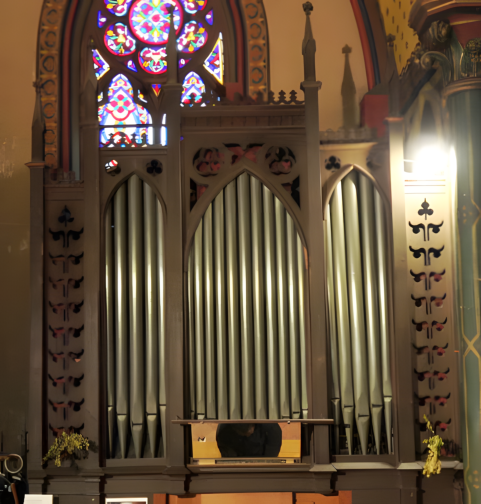
In this church there was a choir organ bearing the
inscription “Repaired by E. and J. Abbey, Versailles”. Its
unusual feature was that it stood in the same gallery as the
grand organ, on the right-hand side when facing the organ
case, and slightly lower down.
The instrument dates back to an earlier construction,
probably contemporary with the building of the church.
Indeed, the general appearance of the surviving elements
suggests an instrument by Suret or Stoltz.
The Abbey firm completely rebuilt the instrument at the
beginning of the twentieth century, and it was inaugurated
“like a grand organ” by Alexandre Guilmant on 25 January
1900 (see *Le Monde Musical* XII/2 [30 January 1900], p.
27).
In 1993, the instrument was destroyed—perhaps ‘inspired’
by what had happened to the grand organ at the nearby
Notre-Dame de la Lorette—and replaced by a new
instrument built by François Delangue in a neo-Baroque
style. It was installed in the old case, reusing some elements
of the original organ.
Source: La Flûte Harmonique, no. 65, 1993